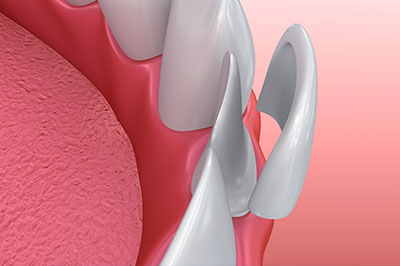
For teeth with imperfections that cannot be addressed with teeth whitening procedures, but are not so flawed as to require full coverage crowns, dental veneers can provide the desired cosmetic improvements.
Dental veneers are custom-fabricated facings that offer a conservative and cosmetically pleasing way to improve the appearance of teeth that are chipped, gapped, worn, slightly crooked, misshapen or darkly stained. With dental veneers, the color, shape, size, and length of the teeth can be changed for the better. Bonded to the front surfaces of the teeth, veneers can be used to enhance the appearance of a single tooth or multiple anterior teeth.
The two most common types of veneers are porcelain veneers, which are also known as porcelain laminates, and composite veneers. While porcelain veneers are the most commonly offered option in care, composite veneers can also achieve excellent results. Starting with a smile makeover consultation and a comprehensive assessment of a patient’s oral health as well as a discussion of the cosmetic goals, the dentist will determine a treatment plan to achieve the most pleasing outcome of care.
Porcelain Veneers
Porcelain veneers are ultra-thin facings that are custom fabricated from the highest grade of dental ceramics and offer the following benefits:
Composite Veneers
When direct composite veneers are the selected method of care, the dentist applies carefully selected shades of tooth-colored composite resins to the fronts of the involved teeth. As the composite resin is placed, it is meticulously sculpted to create the desired shape, length and overall form of each tooth. Each layer of applied composite is then cured with a special light, and additional layers of composite are placed as required to achieve an aesthetically pleasing and functional result. Once the final result is completely set, the dentist will smooth and polish the direct composite veneers to a naturally brilliant finish.
While composite veneers frequently offer the advantages of being a single visit procedure, easy to repair and an economical alternative to porcelain veneers, they are not as strong or resistant to staining and wear as dental ceramics. However, by avoiding certain dietary choices and habits, practicing good oral hygiene and getting routine dental care, direct composite veneers can offer an effective and long lasting cosmetic smile improvement.


Determining if a veneer is suitable or a full-coverage crown is required depends on the extent of the tooth's defects and the remaining amount of healthy tooth structure. For teeth with imperfections that cannot be remedied with a teeth whitening procedure, dental veneers often provide the desired cosmetic improvements. However, a significantly undersized, misshapen, chipped, or darkly stained tooth usually requires a full coverage crown.
Porcelain veneers are fabricated from the highest grade of dental ceramics, which reflect light in much the same way as the enamel of natural teeth. In addition to this feature, dental porcelain is resistant to stains and discolorations, keeping your smile white and vibrant for years to come.
Porcelain veneers are ultra-thin customized facings that become strong and durable once bonded to the underlying teeth. With proper hygiene and routine dental care, veneers provide a cosmetic solution that not only looks and feels completely natural but is also long lasting.
However, just as harmful oral habits can affect your natural teeth, they can also cause damage to your veneers. To prevent chipping, cracking, or dislodging a veneer, avoid nail biting, chewing on hard candies, ice, pens, or pencils, and opening bottles or other objects with your teeth. Also, remember to protect your smile on the playing field by wearing a properly fitted sports mouthguard.
Tooth grinding or bruxism is another important consideration in care. If you clench or grind your teeth, you may need to wear a night guard to help protect your new smile or discuss other options with our office.
As versatile as they are beautiful, dental veneers can be applied to a single tooth in need of cosmetic improvement or multiple front teeth to dramatically improve the look of your smile. Whatever the case may be, dental veneers provide highly satisfying results to create a smile; you'll feel confident sharing with the world.
Among the many benefits offered by dental veneers is their ability to mask a range of imperfections at once. In addition to covering stains or discolorations on the front surface of a tooth, the size and shape of a veneer can also be customize to improve the tooth's contours and dimensions. At the same time veneers create a whiter and more vibrant smile; they can also lengthen or widen a tooth, close minor gaps, and address other minor alignment issues.
The two most common types of veneers are porcelain veneers, also known as porcelain laminates, and composite veneers. Although porcelain veneers are the most commonly offered option in care, composite veneers fabricated directly on the tooth can also achieve excellent results. You may have also heard the term no-prep veneer. It refers to a type of porcelain veneer that requires little to no preparation of the underlying dental enamel. At your consultation visit, we'll discuss your best options in care.
Once they're in place, your veneers are also easy to care for and maintain. Simply by brushing, flossing, and visiting our office for periodic checkups, you can successfully protect and preserve your new and beautiful smile.
Although certain procedures that are considered cosmetic may not be covered by dental insurance, veneers remain a worthwhile investment in your smile. Based on the unique considerations of each case, we develop treatment plans that consider specific dental needs, cosmetic goals, and budget. Our experienced and friendly office staff can address all your insurance questions and review various payment and financing options.
At the office of Dodson Brothers Dentistry, we value patient input and pay close attention to your treatment goals, concerns, and expectations in care. When it comes to cosmetic dentistry, we recognize that every smile is unique and never take a “one size fits all” approach to care. We utilize the most advanced diagnostic technology and treatment methods to assess your smile and to design your porcelain veneers for a precise fit and optimal aesthetics.
As experienced providers of care, we provide highly personalized treatment, combining state-of-the-art technology with an artistic touch to produce long-lasting and aesthetically pleasing results of care.
Porcelain veneers are ultra-thin ceramic shells that are bonded to the front surfaces of teeth to improve color, shape, and alignment. They are custom-crafted to match translucency and texture so they mimic natural enamel and respond to light in a lifelike way. Bonding with modern dental adhesives creates a strong interface that preserves tooth function while improving appearance.
The laboratory process combines digital scans or impressions with skilled shading and contouring to produce veneers that integrate with surrounding teeth. Because porcelain is stain-resistant and biocompatible, veneers maintain their aesthetic qualities when fitted precisely and cared for properly. Proper planning and bonding are essential to ensure longevity and a natural result.
Ideal candidates are patients with healthy teeth and gums who want to correct surface stains, small chips, minor shape irregularities, or narrow teeth without altering function. A clinical exam will assess enamel thickness, bite stability, and gum health to determine whether veneers are appropriate. Active decay, uncontrolled gum disease, or severe bite problems typically need treatment before cosmetic work begins.
Patients who seek predictable color and form across multiple front teeth often benefit from veneers more than from whitening or bonding alone. Expectations should be realistic: veneers are a long-term cosmetic treatment that require routine care and, in some cases, night guards for those who clench or grind. A careful diagnostic process helps identify the most conservative plan to achieve the desired outcome.
Veneers offer a middle ground between conservative bonding and full-coverage crowns: they provide more predictable color and contour than bonding while preserving more tooth structure than a crown. Teeth whitening addresses internal discoloration but cannot change tooth shape or close gaps, making veneers a better option when form and shade must be corrected simultaneously. Composite bonding can be quicker and less invasive but may stain or require more frequent touch-ups.
Crowns are recommended when a tooth has extensive damage or structural weakness, whereas veneers are ideal when the underlying tooth is sound and the concern is primarily cosmetic. Each option has trade-offs in terms of preparation, durability, and aesthetic control, so a tailored consultation will identify the safest, most effective approach for each patient. Digital previews and mock-ups help compare likely outcomes across these alternatives.
The process begins with a comprehensive consultation that includes photographs, digital scans or impressions, and discussion of aesthetic goals. A diagnostic plan and mock-up allow patients and the dentist to preview the proposed shape, size, and shade before any enamel is removed. Minimal tooth preparation typically involves reducing a small amount of enamel from the front surface so the veneer sits flush with adjacent teeth.
Temporary restorations may be placed while the custom veneers are fabricated in the lab, and final placement involves careful trial fitting, shade verification, and bonding with a strong adhesive. After bonding, the dentist will refine the margins and polish the restorations to ensure comfort and proper speech. Follow-up appointments monitor fit and gum health to address any adjustments early.
Achieving a natural appearance requires attention to shade, translucency, surface texture, and proportions rather than selecting the brightest possible color. Dentists use shade guides, digital photography, and communication with skilled technicians to reproduce internal hues and light transmission that match surrounding teeth. Subtle texturing and edge design help veneers blend so they respond to light as natural enamel does.
Facial features and tooth-to-lip relationships are considered when selecting shape and length to create a balanced smile arc. The lab can layer ceramics to emulate depth and vitality, and clinicians verify the match at try-in to confirm harmony with adjacent teeth. When laboratory artistry and clinical technique align, veneers integrate seamlessly into the smile.
Contemporary veneer techniques aim to be as conservative as possible, typically requiring only a small reduction of enamel from the front surface to accommodate the restoration. The exact amount of reduction depends on the type of veneer and the existing tooth contours; in many cases, ultra-thin or no-prep veneers can minimize or eliminate enamel removal. Preserving enamel is important because it supports strong bonding and long-term tooth health.
When more extensive reshaping is needed for alignment or proportion, the dentist will explain the rationale and explore alternatives such as bonding or orthodontics. A thorough diagnostic evaluation helps determine the most conservative option that achieves the aesthetic goal while maintaining structural integrity. In all cases, careful technique and accurate planning protect the underlying tooth and surrounding gum tissue.
Caring for veneers includes routine dental hygiene—brushing twice daily with a nonabrasive toothpaste and flossing daily—to keep margins clean and prevent gum inflammation. Regular professional cleanings and dental exams allow the dentist to monitor margins, contacts, and bite relationships. Avoiding habits that stress the teeth, such as using teeth as tools or chewing very hard objects, helps prevent chips or fractures.
Patients who clench or grind should discuss protective options, such as a custom night guard, to safeguard veneers and natural teeth. While porcelain resists staining better than natural enamel, maintaining consistent hygiene and periodic polishing preserves the appearance. Promptly report any looseness, sensitivity, or changes in bite so the clinical team can evaluate and address concerns early.
With proper care and regular dental follow-up, porcelain veneers commonly provide many years of reliable service, though individual longevity varies based on several factors. Quality of the initial bonding, fit, and occlusal (bite) management play major roles in durability, as do the patient’s oral hygiene and behavioral habits. Trauma, bruxism, and improper use of the teeth can shorten the lifespan of restorations.
Routine maintenance visits allow the dentist to identify early signs of wear, marginal breakdown, or gum changes and intervene conservatively when needed. Timely management of minor chips or wear can often extend the functional life of veneers. A proactive partnership between patient and clinician helps preserve aesthetics and function for the long term.
Potential risks include sensitivity after enamel reduction, marginal staining if hygiene lapses, and the possibility of veneer fracture or debonding under unusual stress. Inadequate preparation or poor fit can lead to gum irritation or recurrent decay at the margin, which is why a careful clinical evaluation and precise laboratory work are essential. Patients with active gum disease or unstable bite relationships require treatment of those conditions before cosmetic veneer placement.
Conservative repair options exist for some chips, but significant damage may necessitate replacement to restore aesthetics and function. Regular monitoring and early intervention reduce the likelihood of major complications. Clear communication about expectations, maintenance, and protective measures helps minimize risk and supports a successful outcome.
Begin with a consultation at our Kihei office to review your concerns, medical and dental history, and a clinical exam that includes photographs and digital scans or impressions. The diagnostic process allows us to evaluate enamel thickness, gum health, and bite dynamics and to present conservative alternatives when appropriate. Digital mock-ups and provisional restorations can help you visualize outcomes and make an informed decision before any irreversible steps occur.
Our team focuses on creating natural, proportionate results that complement your facial features while preserving tooth structure whenever possible. If veneers are chosen, we coordinate precise laboratory work and careful bonding to achieve predictable aesthetics and function. Schedule an appointment to discuss whether veneers are the best path to meet your smile goals and to learn what the customized treatment plan will involve.

Have questions, need to schedule an appointment, or want to learn more about our services?
Our friendly team is ready to assist you. At Dodson Brothers Dentistry, we make connecting with us easy, convenient, and stress-free.